Showing posts with label food security. Show all posts

July 26, 2012

Broccoli and the Super Garden

We returned from camping last weekend and it was as if my garden had suddenly come alive! Everything had literally grown two feet!

Cucumbers (lemon, straight 8's and a pickling variety).


I may have gone overboard with the amount of plants, we will see.

The tomato's are finally kicking it in gear and surviving their flea beetle infestation.


There are even blooms!

The pole beans are making their way up the bamboo:


They are definitely a bit crowded, but so far do not seem to mind.

The hugelkultur is becoming a bit overwhelmed by the volunteer squash so I keep trimming back the squash and redirecting their vines. Do any of you know what that feathery tree like looking plant is in the middle of the photo? I do not recognize it from any of my seeds....it may be a weed...


Two lovely broccoli heads were picked last night:

They smell delicious, I cannot wait until the hubs cooks them up in something yummy. There are at least four more forming in my brassica bed.

July 25, 2012

Cherries!

We try to pick cherries each summer, Northwest cherries. They almost rival Oregon strawberries. We have a secret farm out in the Columbia Gorge that we go to year after year. You have to call ahead to arrange for a picking time, but at 75 cents/pound, it is a steal. This year my mom and her friend ended up picking for me as time was running out and we could not find times that worked for everyone.

My mom ended up picking one and a half flats of cherries for me last Thursday.  However we were leaving for a three day camping trip on Friday, so I had to do something with them before we left. I used my fabulous pitter!


My mom found this pitter last year...possibly at a garage sale, we cannot remember, but it works pretty well. I found this one on Amazon, if you cannot find a used one.  It is probably $30 well spent if you love cherries. It took me about 25 minutes to pit all my cherries (1.5 flats). While eating some this week (frozen-the perfect sweet snack) I discovered that a percentage of them still had their pits, but I am willing to live with that. Maybe if I took more time to review my work before I dumped them in freezer bags....

The results were a bit graphic:

Cherry pitting masacre


But oh so delicious.

June 11, 2012

Nano Kitchen Garden

The Hubs sends me links every day to my email inbox. They are usually from those websites that focus on the obscure and weird and usually tend toward the sci-fi end of the spectrum.

Occasionally, they are actually interesting ideas, based in reality.

Behold, the Kitchen Nano Garden:


It is apparently the kitchen gadget of all kitchen gadgets. A fully self contained kitchen sized greenhouse, with full spectrum lighting and built in hydroponics.  If I lived in a uber-urban city like Tokyo or London or New York, I could see how this gadget would appeal to me.

But for now, I prefer to get my hands dirty in the dirt, outside my house, under the actual sun surrounded by chickens.

May 14, 2012

Radical Acts of Defiance

Have you seen the cover of Time this month?

I have been trying for the last week to clarify my thoughts about how many ways this cover and the article included inside infuriates me.

Luckily, Erica at Northwest Edible Life has said it perfectly. Check out her post, Radical Acts of Defiance.

I truly hope all the moms out there enjoyed this gorgeous weekend.  Happy Mom's Day, and know that you ARE mom enough.


April 5, 2012

Seed Starting Challenge

April's Urban Farm Challenge is seed starting!  Erica at Northwest Edible Life has all the details HERE.  If you leave a comment on her blog about what you are growing this month you will be entered to win a year of Urban Farm Magazine.  Yes, there is a magazine for that.  I have bought a few copies over the years and learned some great information about bee keeping and soil building.

You can see my current seed growing operation here and here.

This is where my seed starting experience started at my old house.  The only space I had was the top of my washer and dryer...and I used a desk lamp.  To my surprise this worked out fine.  I grew some great tomato's that year.


Are those not lovely August toms?  All started on top of my dryer in February.


This years setup comes complete with a guard cat:


This year I have planted seed for an herb garden Neverella and I are going to plant in the sunny part of the backyard.  Now that the chickens are being penned in a rotating field style operation, I can plant what I want in the flower beds.

New to me herbs started this year include borage, chamomile, echinacea, sage, bergamot, calendula.

I am also using NW Edible's seed database this year, it is fantastic and she offers it on her blog for FREE.

What are you growing this year that is new to you?

March 15, 2012

Grow Op Progress

The little seedlings are growing growing GROWING!

I need to get my cold frames prepped this weekend, so I can move everything other than the tomatoes outside. My seed setup is working quite well, although I would like to have a water wand right next to my seedling trays, just like Erica at NW Edible Life!

These little guys need to get outside in the cold frame.


Eddie seems to think this is a nice warm place to sleep.  The heating pad she is laying on is not even plugged in!

You can see the tomatoes are looking quite strong and healthy.


What is your favorite plant to start indoors?

March 12, 2012

March Classes and Events

Events around the Portland Metro this month:


March 13th 
InFARMation (and Beer!)  at Holocene
5:30pm-8:30pm
Topic: Chickens in the City, Chickens in the State
"Our panelists this month will cover keeping chickens in the city, and also discuss the larger picture of poultry in Oregon. Have you noticed how hard it is to find pastured poultry to buy, especially at grocery stores and restaurants? Most Portlanders at least have a neighbor with chickens, so why isn’t pastured chicken abundantly available? Our speakers this month includes Joe and Karen Schueller, ranchers from Rainshadow El Rancho and co-founders and operators of Scio Poultry Processing, Heather Havens, general manager of Concentrates, Inc, and Karen Wolfgang, owner and project coordinator for Independence Gardens."
Cost: Free

March 31st

Intro to Backyard Chicken Keeping at Zenger Farm
10am - Noon
"This workshop will cover the basics of backyard chicken keeping, from raising chicks, shelter, and feed, to municipal regulations and which chicken breed is right for you. The workshop will include a slide show in the farmhouse, a tour of the Zenger Farm hens and their mobile coop, and plenty of time to get all your questions answered. Children are welcome to come along."
Cost: $10-$25 sliding scale, donation to Zenger Farm

February 29, 2012

Lexicon of Sustainability

This is one of the most intriguing and graphically stimulating projects around food sustainability I have ever seen.  Truly beautiful images about some of the lesser known (and well known) movers and shakers in this movement.  Go to the site itself.

I need a Farm Fairy.

http://www.lexiconofsustainability.com/pop-up-art-shows/farmfairies/


February 13, 2012

Urban Farm Challenge 2012

Another blogger and author, Annette Cottrell, has initiated an Urban Farm Challenge for this year, and YOU should join in! Here is the link - Urban Farm Challenge 2012

Have you ever wanted to grow some of your own veggies but did not know where to start? Each month she will be addressing another urban farming issue; composting, seed saving, preserving etc.

"Yes, yes, urban farming is about vegetables and chickens and putting up but what it’s really about is changing the food stream. It’s about a hunger to connect with what you eat, and what you feed to those you love. It’s about being mindful of the impact you have on this life, both on and off the farm."

She also wrote the "Urban Farm Handbook", which I do not yet own, but I think I may be adding it my library.  I have read many positive reviews, one from Food in Jars.

February is all about the soil.  I already compost our kitchen and some yard waste in our backyard composter. The City of Portland also picks up yard debris and the kitchen waste I do not place in my garden compost (meat, cooked food, greasy food etc.) curbside along with recycling and garbage.

We used to have one of these barrel type composters that sits on the ground, but developed a vermin problem.  A family of rats moved in - chewed right through the barrel - so we had to come up with a different solution.  Aside from the fact that rats carry disease, they were eating all my kitchen scraps before it could compost and I did not want them to try to get into the coop and start eating my eggs and chicken feed!  Our coop has hardware cloth buried 12" in the ground all around, but I was taking no chances.


My aunt actually got us the composter you see here.  It sits up on metal legs and as soon as we converted to it, the rats moved away!

The other composter was really difficult to manage...it was next to impossible to stick a shovel or fork in there and get any leverage to turn the soil.  This one is hinged and it takes some effort, but it can be turned regularly to mix up the compost.  Some people in dryer climates have trouble with compost tumblers drying out....this is not a problem here in the northwest.

The Hubs came across an article about Hugelkultur garden beds.  We are going to try this method out this month and plant it this summer and see how it goes.  I will keep you posted.

http://www.richsoil.com/hugelkultur/
Be sure to sign up for the challenge and then post about your efforts on Annette's site.

February 10, 2012

February Events

Some events around the Portland area this month:

February 11th 
Join the Zenger Farm Beekeepers to learn the basics of backyard beekeeping. Learn about city regulations, bee needs as well as the various hive options, equipment needed, and seasonal tasks. If weather (and bees) permit, we will be taking a closer look at the Zenger Farm hives.
Cost: $35-50 sliding scale
Taught by Laura Dalton

February 14th
InFarmation and Beer - Genetically Modified (GMO) Crops, specifically from the viewpoint of a farmer and seed grower, a local food processor and a professor that has done extensive research on genetically modified crops.

Sponsored by Friends of Family Farmers
Location - Holocene (1001 SE Morrison, Portland)

February 15th
Love Your Farmer Day: February 15th, 3:30-7: Stop by the Farmers' Market and warm up our winter farmers with some love. Warm drinks will be flowing, seeds will be swapping, and vegetables will be abundant.
Location - People's Food Co-Op (SE 21st and Tibbets, I block north of Powell, Portland)

Seed Swap: 3:30-5:30: bring your seeds - old and new - to swap with other garden enthusiasts. We will provide small bags to carry your new seeds home in.

Garden Planning Workshop: 5:30-7pm: Taught by our friends at Growing Gardens, learn the basics of starting and maintaining your own vegetable garden. Free and open to the public. Call the store to register.

February 26th
Backyard Chicken Keeping Basics, Urban Farm Store
5:30pm
Details and tickets: http://urbanfarmstore.ticketleap.com/basic-chicken-keeping-class/

February 9, 2012

Grow Op Update - First Planting

I planted some seeds last weekend.

NW Edible Life has fantastic lists for projects to do in preparation for your garden, check out her Monthly To Do Lists.  I love that she is also in the Pacific NW, if a bit farther North and so our to-do's are in sync.

I already have rhubarb and asparagus growing in our garden, so that was done!  (I also love checking things off of lists)

Under the grow lights went the following: cabbage, brussel sprouts, broccoli, green onions, leeks, tomato's and peppers.

We have onions and garlic growing that I planted last Fall, they all have nice green shoots coming out of the ground.  Hopefully any frosts do not harm them.

I am going to get some lettuce and other greens going in large pots to set out on the porch. My plan is to plant greens every month so I have a continuous supply this year. I need to get some peas in the ground, and also decide where I am going to set up the cold frame this year.

Most of my seeds are ordered from Nichols Garden Nursery, because I like their selection, although I do buy a few from Territorial or Seed Savers Exchange. This time of year it is hard to resist the seed displays when at the farm store getting chicken feed. I long for warm sunny days and the brightly colored seed packages seem to make me feel better.


February 8, 2012

Egg Anomaly

Sometimes they just don't come out quite right.

My Americauna, Godzilla, laid this little bitty egg yesterday.  Inside it had just a wee spot of yolk surrounded by whites. It became part of some yummy french toast the Hubs made!

Chickens do not always lay perfect eggs. This is something that in concept makes sense - nature is not perfect, but is hard to fathom until you see it for yourself. Sometimes the eggs comes out elongated, sometimes much more round.  Sometimes they have odd calcium formations on the ends. Knowing how many eggs my girls lay that are odd, the factory egg farms must throw out a lot of eggs in order to fill all those egg cartons with perfectly formed eggs.  What happens to them, I wonder?

The little brown one with spots was laid by our Dominique, Pepper.  Her eggs are almost always spotted, but occasionally they are not. They are all usually this same size, small (in comparison to regular sized supermarket eggs).

The white/pinkish one on the right was laid by S'mores, our other Americauna.  She should lay green or blue eggs, but she instead lays pink ones. Nature is not perfect, or she may be a cross, who knows. I do know she lays the biggest eggs of all my current girls.  They are about the size of the supermarket "extra large" eggs.

My younger girls should start laying in the next few weeks, it will be fun to figure out which hen lays which egg.  It may be a challenge to keep track of eight layers!

February 6, 2012

Life and Death on the Urban Homestead

Disclaimer:  This post is a bit graphic in nature.  Please make your own decision as to whether you really want to read about the real life slaughter of chickens.  There will be some photos that some people may not want to see.  However, this is a part of my journey and the reason this blog exists, so I am going to share my experience.


Read on at your own risk:

Yesterday we culled our first chicken.

I have a lot of mixed feelings about eating animals, let alone killing them myself. I was vegetarian for over seven years in my twenties, and it was really only in the last few years that I have fully embraced and accepted being a meat eater. However, now that I do eat meat more regularly I am even more acutely aware of the adverse impact that industrial agriculture has on our planet and our society and the quality and sources of the meat available for our consumption. One of the purposes of my urban farm journey is to lead my family to a place where we are producing a majority of the meat we consume.

The first step is actually being able to slaughter my own animals and prep them for our table. We enlisted the help of a friend of ours, Greg, that spent some time in the Peace Corp in Tonga, an island in the South Pacific, where he had a lot of experience slaughtering chickens (along with many other meaningful experiences, I am sure).

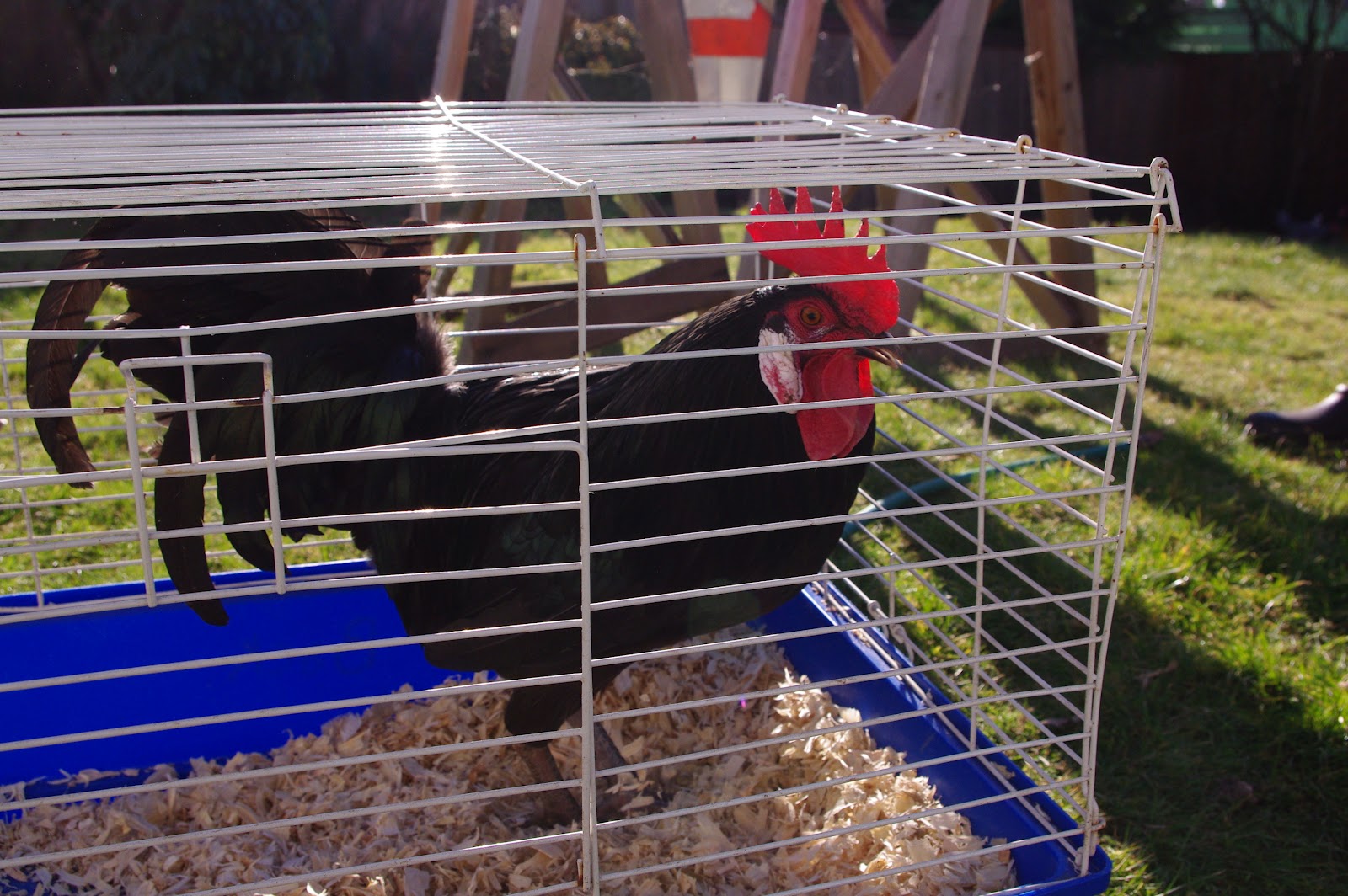
As I posted about a few weeks ago, turns out we had a rooster in our last group of chicks. You may recall......I KNEW IT. In the City of Portland, it is illegal to keep a rooster, so one way or another he had to go. We decided we needed to learn how to slaughter and process our own chickens, especially since we want to get some meat chickens this summer. My friend also has a rooster she needed to cull from her flock as her and her six year old son could not even go out in their backyard anymore without being harassed and chased by him. They had considered keeping a rooster in their flock as their lot is in a bit more rural location outside of Portland, but he was becoming a nuisance. Unless you are going to breed chickens or have enough space to add to your flock using your own rooster, you need to either re-home your roosters or cull them from the flock. It is difficult to find farms around the Portland area that actually want your accidental rooster, there are just too many backyard chicken keepers trying to find non-kill options for their 90% sexed chick that happens to be a rooster.

I knew taking my rooster's life was going to be difficult for me, and it was.  Taking a life should never be easy, and today was no exception.  I shed tears for Coco today, surrounded and supported by the Hubs, and my friends. I will take solace in the fact that his short life was filled with days free ranging in my yard with his ladies. We did the deed as humanely and as quickly as possible using the kill cone.

Goodbye Coco, you were a beautiful bird.


Goodbye Lucky.


We started by setting up the kill cone, set the water to boiling in our large tub, and gathered large stainless steel bowls, knives and ice to the station we set up in our backyard.

The kill station.
As usual, I prefer not to buy things I can construct or put together from stuff I already have. So in true DIY fashion, we "obtained" a slightly used traffic cone and cut off part of the end.  The sawhorses and wood are from our garage, and we just have lots of buckets.

Coco was a very large bird, it did take two of us to hold him.
Going to find and capture the rooster was the point where I just had to get into the zone and get the job done. Coco and I said our goodbyes and then the Hubs and I placed him head first into the cone, our friend Greg was ready with a very sharp knife to slice off his head.  The whole thing took only seconds and it was over.  The hard part for me was the death throes and this is when I shed the tears. However, the cone prevented him from running around and it was all over in a few minutes.

Next step was dunking the carcass in very hot water to loosen the feathers.


It was surprising how easily the feathers came out.  At this point we were all reminded that yes, chickens are carnivorous and cannibalistic left to their own devices.  Note my older girls hovering behind us.


We removed the feet and then placed the bird in a tub of ice water to chill it quickly.


While Coco was chilling, Brit said her goodbyes to Lucky.  Lucky was dispatched just as quickly and after plucking we set him to chilling while we butchered the other carcass.


We did not have a scale, but I think that Coco after gutting, weighed in at about 7 pounds.

When butchering a chicken the main idea is to keep the digestive system in tact as much as possible so you do not soil your meat. Use a very sharp knife and make shallow cuts.

First you remove the oil gland just below the tail and throw it away. We then carefully separated the esophagus and the windpipe from the neck, removed the crop and threw it away.

Intestines and gizzard.
The next step is to remove the organs by slicing a hole directly above the cloaca (vent). This part was a bit tricky, but the Hubs performed admirably, slowly separating the organs from the skin and tail.  At this point it was handed to me to reach inside the cavity and separate all the tissue from the body. Once all was separated you can just pull the entire organ package out of the bird - carefully, trying to keep all the organs in tact. This entire process was a fascinating biology lesson for me. I learned a lot about my chickens today, that will likely serve me well in caring for their health in the future. The last thing we did was to remove the neck and save it for making stock later, it is in fact bubbling away on our stove as I type this post.

We saved the gizzard, liver and the heart, many people enjoy these organs, however the Hubs and I are not those people. Greg intends to take them home with him.  The gizzard has to be split open and the inner lining removed.  The lining of the gizzard is really tough as it has to be to hold all that grit they use to grind their food.

Here Brit is holding the gizzard and you can see the yellowish lining.
As you can see, Pepper is lurking - again.

The Hubs made our bird into a fantastic Hungarian Paprikash, which we thoroughly enjoyed.


Now that the pesky cockerel is gone, the girls can get back to their leisurely life foraging and sunbathing at the Pollo Loco convent.


Eureka says "Rooster, what rooster?"

January 30, 2012

Setting up the Grow Op

Today I took on the task of getting my seed growing area cleaned up and ready to go. My growing area is located in our spacious unfinished basement. Needless to say, after a few months of no use, my allotted area begins to accumulate all kinds of things that belong elsewhere. So today I put all those things away in their proper locations and covered my particle board-cheapest-tables-ever from Ikea with some new plastic sheeting to keep them from getting wet. Last year I used the plastic from a wall painting session and it was too flimsy and got too many holes too easily. I bought the 2 mil stuff this time, will see how it goes.

Grow Op Central


One of my lights has actual full spectrum lamps and the other has regular fluorescent lamps. I was worried last year that the regular lamp would not work as well, but that is not the case. I have researched this issue and the plants do in fact grow better with full spectrum, but the seedlings are not that particular. So I move the larger plants under my full spectrum lamps when they are ready.

I plan to start some tomatoes next weekend. I start them early to try to give them a head start on our summer growing season. The last couple summers here have been so cold and wet that the harvest has not been ideal, but by starting them early I at least do get somewhat of a harvest.

Potting Station


This is my planting station. This is one of the things that my Mom added to this house and I am so glad she did! There is running water, storage and the best part can be seen in the next photo.

Dirt drawer!


There is a grill in the countertop over a dirt drawer! Makes potting up plants and setting seeds so easy, and less messy. (The cabinet was an original kitchen cabinet.)

I have gone through all my seeds and organized them into a one container separating them by plant family. I have logged everything into my new seed spreadsheet. I found this new spreadsheet on NW Edible Life, it is a free download and I love how you can track the age of your seeds and add notes about how the veggies turned out.

Then I attached one of my old wood boxes to the wall above the cabinet to hold the seed I save from my garden and my extra jars.  Empty spice jars are perfect for saving seed.

Seed storage

January 19, 2012

Which Potato Would You Rather Eat?

This child learned a valuable lesson about the toxins in our food supply from a school science experiment.


Our family simply cannot afford to buy all organic fruits and vegetables 100% of the time.  This is the primary reason I wanted to grow our own food.  At the least, I know the food I grow has not been exposed to any directly applied toxic chemicals.  There are airborne toxins that likely float into my yard from the neighbors or the nearby traffic, but at least I know that my produce is much less toxic that that of the conventionally grown produce available at the local market.

Pesticide/herbicide use poisons soils and thereby poisons food.  There are those out there that tout, along with Monsanto, that the use of Round Up is acceptable.
"Among the growing concerns over heavy use of glyphosate based pesticides are links to human and livestock health risks including cancer, fertility issues, birth defects, organ damage and neurological disorders."
Pesticide/herbicide use is not acceptable when it comes down to my family's health.  It is not acceptable in relation to the way it damages soil and compromises the health of farmland and pollinators.

<steps off soapbox>

December 13, 2011

Town in England Growing all their Own Food

Inspiration of the day:

The town of Todmorden in West Yorkshire, UK plans to grow all its own vegetables by 2018!  This is a town of 15,000 people, with a varied socio-economic mix of residents.  They are planting herbs, vegetables and berry vines all over town, and encourage anyone who wants some of the produce to take what they need.

Town-sized self sufficiency, a huge goal that will move them quickly in the direction of taking control of their food system.

Garden revolution.  Love it.

Next up regional self-sufficiency!

Mexican Sunflower

October 26, 2011

Food Swap Follow Up

The food swap was a lot of fun! It was so exciting and inspiring to see all the items everyone had put their creativity, love and time into making.


There were jams and jellies, sauces and chutneys and pesto, beer, liqueurs, produce from urban gardens, all kinds of things pickled and fresh chantrelles picked that morning in the local forest!

And homemade challah!  From another local blogger Jessica of We Gather in the Woods.


The hubs joined me, the curiosity of this event was too much for him to resist. I am really glad he came with me as he really helped during the crazy swap period as it got a little chaotic. But definitely fun chaos. He also helped in explaining some of the things I brought. I did go ahead and make a few lotions and balms....I am so glad I did as they were a big hit! I discovered too late that someone had brought home made ice cream...bummer.

Here is our loot from the night:

Tomato butter, cranberry sauce and chutney, gluten free crackers, walnut liqueurs (score!), pesto, kimchee, vanilla pickles, asian pears, maraschino cherries, a strawberry plant, a large jar of dried Italian plums, CHOCOLATE PEANUT SAUCE (I mean c'mon!). And the chantrelles....I consider these one of THE best items I scored at this swap--we ate them tonight sauteed in butter and garlic over a yummy scramble The Hubs made.

There are links to PDX Swappers here.  The next swap is December 11th, see the info on their site.  I plan to bring more potions and maybe some of my raspberry wine....and maybe my mom, she was pretty excited by the loot!

Pollo Loco swap offerings - note the little ingredient tags.